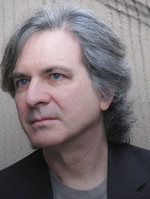
FEATURED REVIEW: Music And Sweet Poetry: Choral Music Of Matthew Harris
This is a major release for choral fans. I've known about Matthew Harris since my college days, when our choir director programmed some of the Shakespeare Songs for his chamber choir. His diversity of styles, accessibility, and real feeling for the choral idiom continue to appeal to choirs around the world.
Whether in Latin, Spanish, or English, Harris brings out individual voices with a remarkable clarity. The aforementioned Shakespeare set not only features a lovely fidelity to the original texts, but also proves harmonically challenging and quite stunning in terms of contrast and emotion. The Latin pieces are ravishing, yet not afraid to be different in terms of what we would normally expect from sacred music. There's a modern twist on the Ave verum corpus in particular that is purely in this composer's style, but also manages to retain the necessary reverence and purity that these texts demand. Conversely, the Ave Maria is a simple prayer, drawing influences from the both the minimalists and also great chanted works of the past. O vos omnes, the last of the four Latin pieces here, is gravely and eloquently articulated, with some unexpected harmonies and seemingly effortless poetry.
The Shakespeare set is mostly splendid, really evoking the meaning of the words with some impressively felt text-painting. The remaining works are distinguished examples of great choral writing…the composer maintains a highly individual voice throughout the program. I have nothing against artists who create harmonically beautiful works that imitate our finest choral composers working today, but isn't it even better to just be one of the finest choral composers working today?
CD review of the all-Harris album, Music and Sweet Poetry
Brian Wigman, Classical Net, May 2014
MORE REVIEWS
“[In the Arms of Music was] extraordinarily diverse and full of fresh, interesting musical ideas that ranged from brooding drama, to elegant beauty, to humor, and to, well, quirkiness... sounds that I've never before heard...a tour de force...my enjoyment was clearly shared by the many audience members who rose to their feet...”
The Sacramento Choral Calendar 2/9/14 |
|
“The Mark of Cain...is suffused with incense. The words are well set and intelligible... tunes are catchy... the music for the Serpent is in a sort of Arabian Nights vein — as the old saying goes, the Devil gets the best tunes. The orchestration is inventive and effective and gets a lot of sound out of eighteen players. There is a touching ending in which Zellah cradles the dying Cain in her lap while she sings him a lullaby their mother Eve used to sing to them as children.”
Opera Review: New Music Connoisseur, Fall/Winter 2012 |
|
|
“Matthew Harris [is] increasingly popular as a choral composer in the USA. On the evidence of the four Shakespeare settings we heard, it’s only a question of time before his music reaches a wider audience. They are very singable, lilting and rhythmic, with an intriguing touch of syncopation: and “O Mistress Mine,” sung also as an encore, is a little masterpiece. More please.”
Bath Chronicle, 7/2/12 |
|
|
“…consistently excellent music that can easily stand on its own without reference to the artworks…some of the finest chamber music of recent vintage I know. Each of Harris's seven, three-to-four minute movements is well crafted, exudes character, and stimulates the imagination.”
Fanfare Magazine, May 2010
(Two CD reviews of “Starry Night: Seven Paintings for Violin, Cello & Piano) |
|
|
 |
“I especially liked "Three Plums," harmonically pungent settings of poems by William Carlos Williams. The chorus also offered Mr. Harris's undulant, fresh and sometimes fractured "Fantasy on La Bamba."”
Anthony Tommasini, The New York Times 5/23/13 |
|
“The chamber chorus sang the New York premiere of three lively, engaging and lighthearted “Shakespeare Songs” by the composer Matthew Harris. The words come from lyrics in the Shakespeare plays that would have been performed with tunes of the day.”
Anthony Tommasini, The New York Times 6/3/12 |
|
|
|
“Harris has a real melodic gift and great wit. His take on Matisse’s “The Piano Lesson” is that it’s the lesson from hell; frantic arpeggios, metronomes, wrong notes stopping things cold. His “Broadway Boogie Woogie” (after Mondrian) is sneaky and funny. He also has a lyric gift, as in the way the Van Gogh movement opens up “cosmically” near the end, and the genuinely dark mystery that gets under your skin in James Ensor’s “Masks Confronting Death.””
Fanfare Magazine: Jan 2010 |
|
|
“This is the sixth such set in Harris’s catalogue and, as in many of his other settings, the songs are singer- and listener- and, best of all, Shakespeare-friendly. Harris handles textures very well. Texts that need to be heard are heard, and Harris has a nice ear for interesting and varied sonorities.”
The Washington Post 5/18/09 |
|
BLASTS FROM THE PAST
“Gratifying..smart and harmonically pungent music”
Anthony Tommasini, The New York Times, 5/21/05 |
|
“One great find here is Matthew Harris, whose delicious set of
seven "Shakespeare Songs" are a delight, jazzy and lyrical in turn. ”
St. Louis Today 11/6/04 |
|
|
“The most engaging work in term of wit, originality and craft was Matthew Harris’s Potpourri…doing for the tango perhaps what Ravel’s Le Valse did for the waltz.”
Herald-Journal CNY, 6/22/98 |
|
|
|
“This is a joyously eclectic group of pieces in which Harris exhibits a variety of influences, including Palestrina, the Beatles and “doo-wop.” His approach… is sometimes reverent and other times light-hearted.”
Choral Journal, August 1996 |
|
|
“Harris achieved a nice Oriental feeling in these often-intense pieces. Their strongly concentrated expressive values were well brought off.”
The Houston Post 10/1/86 |
|
|
|
“His style recalls his primal rock, blues and jazz influences—but in an overall context of skillful harmonic invention and classical sophistication.””
American Record Guide, March/April 2005 |
|
“…a marvelous sense of word painting inhabiting a composition filled with craft…here was that balance of head and heart that marks music of substance.”
Classical New Jersey Society Journal, 1/23/03 |
|
|
“There is a young composer…who I now regard as a genius. Harris has obviously absorbed all the musical influences available in our great mongrel culture [and] has spun this dross into pure gold…I strongly urge that you go out and buy this disc.”
Fanfare, November/December 1994 |
|
|
“Bravo, Mr. Harris, wonderful music!”
Chattanooga News – Free Press, 9/27/91(Chattanooga Symphony review) |
|
|
“Harris’s setting for voice of five poems by Amy Lowell was the most attractive music for me in terms of cumulative, atmospheric effect.”
Houston Chronicle, 10/1/86 (two Houston Symphony reviews) |
|
|
“Matthew Harris’s Starry Night…was notable for its elegant, albeit misty timbral effects…curt pre-emptive endings, which have their own self-effacing wit [and] the kind of personality that kept our attention.”
Bernard Holland, The New York Times 12/12/84 |
|
|
“Coloristically Bold.”
John Rockwell, The New York Times, 2/17/83 |
|
|
|